Archive

For the Tech category

My Rant to Mark Zuckerberg on Immigration Reform

No Comments

IMG_1727

Hi Mark,

I think you have it wrong. Why do the tech companies that you and I work for need to keep outsourcing talent from abroad? In spit of all the jobs lost the past several years and the high demand for certain skills that our companies continue to generate, shouldn’t we be doing something about that? Why am I such an advocate for getting our trade schools and universities up to speed on such open source technologies that are so badly desired? There is no doubt that skills and the experience in such things are becoming more important than education. We really need to rethink about what we’re doing.

Before I graduated from the College of Business at California State University, Long Beach, I was a part of a task force to obtain a grant from the Boeing Company to help fund mobile equipment and a course taught to students about what we are really looking for in today’s technology job market. It’s still going strong today. Shouldn’t we focus on the American people first before looking abroad. Ah! We can’t because the skills are not here. That is the problem. The American student doesn’t know where to start. Unless they’re lucky to get an intern somewhere, like I did, they get left in the dust when we try to hire them.

I appreciate your support to promote Code.org a few months ago and the importance of teaching our youth to learn to program in high school. But that seems to conflict with what you’re stating above, however. I am all in to hire someone abroad to get the job done, but we can’t sustain this. The media gets this wrong all the time when asking the question, “Why can’t you hire these people from (so and so) after all they’ve achieved?” Because the skills are not there. Let’s do something about that.

Yes, my grandfather fled here from Nazi Germany when he was just a kid and then grew up, working hard for his family of three sons, and started a company that ships its products worldwide. Coming here for the opportunity to freely succeed is what we all want, but many don’t strive or aren’t motivated to do so. But this is a different issue altogether.

I’d appreciate your comments here at Brandin.com.

WWDC 2012 Live

No Comments

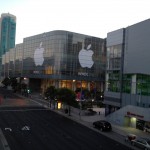
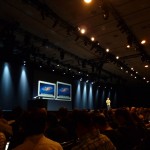
Good morning all! We’re experiencing heavy network problems inside Moscone West which is very typical at this event. This year I was able to get a VIP pass into the event, being able to actually sleep before the big day. I’m about five rows back from the front.

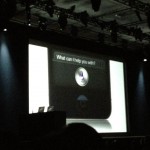
Siri, kicked off the event, yes, Siri, with a bunch of jokes. Well done!

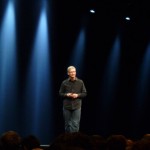
Tim came out on stage and mentioned that WWDC is in its 23rd year, the longest-running

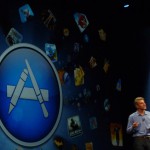
400 million app store accounts have been created. Over 650,000 apps (225,000) have been created. Over 30 billion apps have been downloaded. $5 billion have been cashed out to developers. Tim showed us a video of some life-changing users, including a developer who wanted to help the blind.

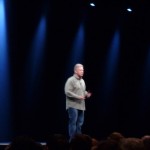
Phil Schiller took the stage getting ready to announce new MacBook Air Hardware with the new Intel ivy-bridge Core i5 & i7. The MacBook Air can load 512 GB of SSD storage. USB3 will be added to the lineup. The iSight Camera will be updated to the same FaceTime camera found in their mobile devices. These devices will start shipping TODAY!

The MacBookPro is also getting an update. They are getting the same Intel ivy bridge family CPU, up to quad-core. They are keeping Nvidia graphics in the line. USB3 is also built-in. This is also shipping today!

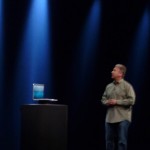
OOO! Here’s a MacBook that is cloaked! Phil announced the “Next Generation MacBook Pro.” Here are some ideas, we need a killer new display, built for the future and lightweight. Here it is! Phil showed us how thin this thing is. 7.1 inches thin! It’s about as thin as the MacBook Air. Yes, folks, this has a “retina” display. 15.4 inches across, 2880 X 1800 pixels. The glare has been reduced by 75%. Up to 16GB  RAM and 768 SSD is available. 7 hours of battery life. New dual mics are installed, perhaps for voice recognition?

Major updates to Apple’s “pro” apps like Aperture will be updated to take advantage of this new display. Other 3rd party apps are on the way.

Phil shows us a video… and Johnny Ive is on screen!

The “new” MacBook Pro will start shipping TODAY!

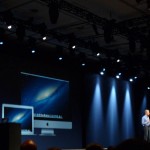
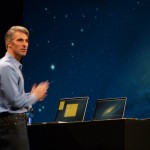
Craig Federici is now on stage talking about OSX (10.8) “Mountain Lion”. Mountain Lion will have 200 new features. We will demo 8 this morning.

All of Apple’s i-apps will be integrated. iWork apps will now have documents in the cloud (do I smell Microsoft?).

iMessage is coming to the Mac. Craig showed us Pages. Notification center is now built-in, not a 3rd party plug-in. Dictation is coming to the mac, just like the iPad. Sharing will bring platforms such as Facebook and Twitter into your apps. The Safari (Webkit) browser will have iCloud features, such as being able to share bookmarks and history across devices. Multi-genture tabs now work across window tabs.

Craig now shows us “Power Nap.” Power Nap will keep your essential background services such as backing up and iCloud connections.

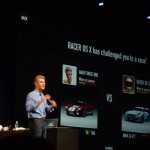
Mirroring now works with the AppleTV, just like your iDevices. Game Center is finally coming to the Mac. Craig demoed both for us. “Racer X” was invited on stage to race a game, Craig lost :-(

OSX Mountain Lion will be released for $19.99 next month. That update includes all the way back to Snow Leopard for all your Macs. If you purchase a new mac today, you get Mountain Lion for free.

Ah, Scott Forstall, of course. Here he comes to talk about iOS.

Most modern Apple devices are in iOS 5, more than 75% of the customer base.

Over 7 billion notifications a day are set out (this is what I do at work).

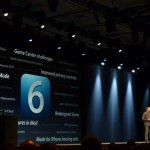
Scott announces iOS6 with 200 new features. He started off with Siri’s new “behavior.” He asked Siri a sports question. She answered it very well. “What is Buster Posi’s batting average? Who is taller, LeBron or Kobe? What movies are playing at the Metreon (across the street)? Show me movies starting Scarlett Johansen… Play Temple Run” She knows it and does it all!

And here it is! Siri can now be integrated into your car! Goodbye Sync. Nine auto manufactures (except ford) have  committed to bringing Siri to your vehicle.

Siri is coming to the new iPad.

Facebook integration is now easier. The settings app will set this up for the user. User will be able to post a status, photo, video, etc. Facebook is also in the AppStore.

Scott showed off enhancements with the “phone” app. You can now ignore a call to send a message or set a reminder to call back via a geofence. A new DND (do not disturb) function will keep your phone silent based on a schedule.

Facetime now works over cellular networks! Facetime will also attach your phone numbers with your AppleId for cross-device connectivity.

“Shared Photo Streams” can send photos to your firends directly without a platform such as Facebook or Twitter.

Passbook can enable users to purchase items like movie tickets, airline reservations, etc. Scott showed us a demo. The feature is live based on where your location is, such as bringing up your boarding pass when you are at the airport.

Guided Access gives users with special needs to use iDevices, such as iPads. This also includes uses in the classroom like keeping a single application on to administer a test.

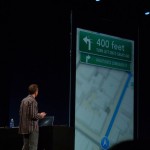
Time for MAPS! Apple is bringing out their new mapping system, saying goodbye to Google. This was entirely built by Apple and will have all the feature you’re used to, such as traffic information. Turn-by-turn navigation will be built-in, with Siri! Maps will be 3D in many metro areas. Scott showed us. Too much is happening here folks. This will be amazing!

iOS6 will be handed out as a beta to developers today. iOS6 ships later this summer for the iPhone 4S, 4, 3GS, the iPad 2, new iPad, and 4th Gen iPod Touch.

Tim is now back on stage, reviewing all the stuff from the morning (to much!). Tim reminded us that “Apple” itself built all this, keeping the culture alive and well, impacting the world.

That’s a wrap folks. Photos will be uploaded later today. Thanks for being here.

Apple’s founding contract expected to bring $150,000 at auction

No Comments

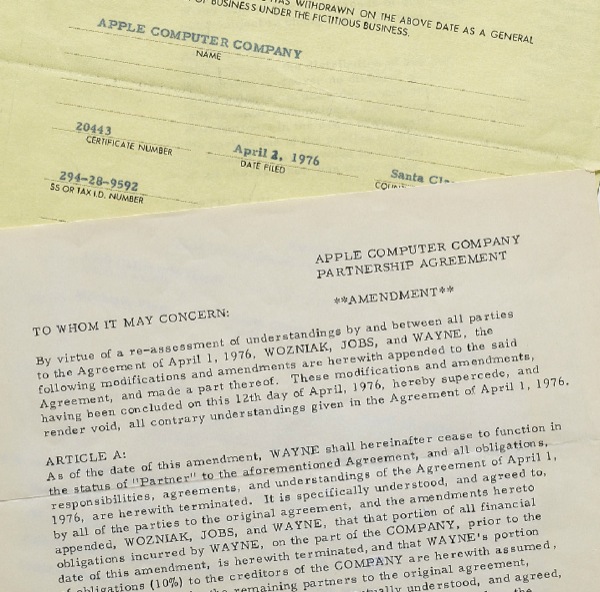
The signed contract that established what would become the world’s most valuable tech company is one of the highlights of an upcoming auction, and is estimated to sell for at least $100,000.

It was revealed on Monday that the document which founded Apple Computer Company in 1976, will be sold by Sotheby’s in an upcoming books and manuscripts auction, reports Bloomberg.

The original three-page draft is signed by co-founders Steve Jobs, Steve Wozniak and Ronald Wayne, and is the third most-valuable lot being sold in the December auction.

“This is a foundation document in terms of financial history, social history and technological history,” said Richard Austin, head of books and manuscripts at Sotheby’s in New York.

Wayne, who was the original owner of the contract, met Jobs while working at Atari Inc. and was later promised a 10 percent stake if he could persuade Wozniak to join Apple. The three founders drafted the official paperwork on April 1, 1976, effectively establishing the fledgling computer company that would turn into today’s tech heavyweight.

On April 12, however, Wayne withdrew as partner, receiving $800 for his share of the company. Sotheby’s notes that he subsequently received another payment of $1500, though by the end of 2010 his original stake would have been worth an estimated $2.6 billion.

A manuscript dealer, who acquired the founding draft from Wayne, sold the documents to the auction house in the mid-1990′s.

“It was right before Jobs rejoined Apple,” Austin said. “At the time, everyone thought that Apple was pretty much finished.”

Jobs, whose closely guarded personal life was recently exposed in a biography by Walter Isaacson, was seen by many as the driving force behind Apple’s dramatic turnaround in becoming one of the largest companies in the world.

The tech guru’s untimely death in October generated an enormous amount of press, which is part of the reason Sotheby’s is selling the documents.

“With everything in the news, this seems to be the time to do it,” Austin said.

Included with the original contract is a statement by the County of Santa Clara noting Wayne’s withdrawal from Apple as well as an amendment to the original draft.

The auction will take place on Dec. 13 in New York.

A Sister’s Eulogy for Steve Jobs

No Comments

By MONA SIMPSON
Published: October 30, 2011

I grew up as an only child, with a single mother. Because we were poor and because I knew my father had emigrated from Syria, I imagined he looked like Omar Sharif. I hoped he would be rich and kind and would come into our lives (and our not yet furnished apartment) and help us. Later, after I’d met my father, I tried to believe he’d changed his number and left no forwarding address because he was an idealistic revolutionary, plotting a new world for the Arab people.

Even as a feminist, my whole life I’d been waiting for a man to love, who could love me. For decades, I’d thought that man would be my father. When I was 25, I met that man and he was my brother.

By then, I lived in New York, where I was trying to write my first novel. I had a job at a small magazine in an office the size of a closet, with three other aspiring writers. When one day a lawyer called me — me, the middle-class girl from California who hassled the boss to buy us health insurance — and said his client was rich and famous and was my long-lost brother, the young editors went wild. This was 1985 and we worked at a cutting-edge literary magazine, but I’d fallen into the plot of a Dickens novel and really, we all loved those best. The lawyer refused to tell me my brother’s name and my colleagues started a betting pool. The leading candidate: John Travolta. I secretly hoped for a literary descendant of Henry James — someone more talented than I, someone brilliant without even trying.

When I met Steve, he was a guy my age in jeans, Arab- or Jewish-looking and handsomer than Omar Sharif.

We took a long walk — something, it happened, that we both liked to do. I don’t remember much of what we said that first day, only that he felt like someone I’d pick to be a friend. He explained that he worked in computers.

I didn’t know much about computers. I still worked on a manual Olivetti typewriter.

I told Steve I’d recently considered my first purchase of a computer: something called the Cromemco.

Steve told me it was a good thing I’d waited. He said he was making something that was going to be insanely beautiful.

I want to tell you a few things I learned from Steve, during three distinct periods, over the 27 years I knew him. They’re not periods of years, but of states of being. His full life. His illness. His dying.

Steve worked at what he loved. He worked really hard. Every day.

That’s incredibly simple, but true.

He was the opposite of absent-minded.

He was never embarrassed about working hard, even if the results were failures. If someone as smart as Steve wasn’t ashamed to admit trying, maybe I didn’t have to be.

When he got kicked out of Apple, things were painful. He told me about a dinner at which 500 Silicon Valley leaders met the then-sitting president. Steve hadn’t been invited.

He was hurt but he still went to work at Next. Every single day.

Novelty was not Steve’s highest value. Beauty was.

For an innovator, Steve was remarkably loyal. If he loved a shirt, he’d order 10 or 100 of them. In the Palo Alto house, there are probably enough black cotton turtlenecks for everyone in this church.

He didn’t favor trends or gimmicks. He liked people his own age.

His philosophy of aesthetics reminds me of a quote that went something like this: “Fashion is what seems beautiful now but looks ugly later; art can be ugly at first but it becomes beautiful later.”

Steve always aspired to make beautiful later.

He was willing to be misunderstood.

Uninvited to the ball, he drove the third or fourth iteration of his same black sports car to Next, where he and his team were quietly inventing the platform on which Tim Berners-Lee would write the program for the World Wide Web.

Steve was like a girl in the amount of time he spent talking about love. Love was his supreme virtue, his god of gods. He tracked and worried about the romantic lives of the people working with him.

Whenever he saw a man he thought a woman might find dashing, he called out, “Hey are you single? Do you wanna come to dinner with my sister?”

I remember when he phoned the day he met Laurene. “There’s this beautiful woman and she’s really smart and she has this dog and I’m going to marry her.”

When Reed was born, he began gushing and never stopped. He was a physical dad, with each of his children. He fretted over Lisa’s boyfriends and Erin’s travel and skirt lengths and Eve’s safety around the horses she adored.

None of us who attended Reed’s graduation party will ever forget the scene of Reed and Steve slow dancing.

His abiding love for Laurene sustained him. He believed that love happened all the time, everywhere. In that most important way, Steve was never ironic, never cynical, never pessimistic. I try to learn from that, still.

Steve had been successful at a young age, and he felt that had isolated him. Most of the choices he made from the time I knew him were designed to dissolve the walls around him. A middle-class boy from Los Altos, he fell in love with a middle-class girl from New Jersey. It was important to both of them to raise Lisa, Reed, Erin and Eve as grounded, normal children. Their house didn’t intimidate with art or polish; in fact, for many of the first years I knew Steve and Lo together, dinner was served on the grass, and sometimes consisted of just one vegetable. Lots of that one vegetable. But one. Broccoli. In season. Simply prepared. With just the right, recently snipped, herb.

Even as a young millionaire, Steve always picked me up at the airport. He’d be standing there in his jeans.

When a family member called him at work, his secretary Linetta answered, “Your dad’s in a meeting. Would you like me to interrupt him?”

When Reed insisted on dressing up as a witch every Halloween, Steve, Laurene, Erin and Eve all went wiccan.

They once embarked on a kitchen remodel; it took years. They cooked on a hotplate in the garage. The Pixar building, under construction during the same period, finished in half the time. And that was it for the Palo Alto house. The bathrooms stayed old. But — and this was a crucial distinction — it had been a great house to start with; Steve saw to that.

This is not to say that he didn’t enjoy his success: he enjoyed his success a lot, just minus a few zeros. He told me how much he loved going to the Palo Alto bike store and gleefully realizing he could afford to buy the best bike there.

And he did.

Steve was humble. Steve liked to keep learning.

Once, he told me if he’d grown up differently, he might have become a mathematician. He spoke reverently about colleges and loved walking around the Stanford campus. In the last year of his life, he studied a book of paintings by Mark Rothko, an artist he hadn’t known about before, thinking of what could inspire people on the walls of a future Apple campus.

Steve cultivated whimsy. What other C.E.O. knows the history of English and Chinese tea roses and has a favorite David Austin rose?

He had surprises tucked in all his pockets. I’ll venture that Laurene will discover treats — songs he loved, a poem he cut out and put in a drawer — even after 20 years of an exceptionally close marriage. I spoke to him every other day or so, but when I opened The New York Times and saw a feature on the company’s patents, I was still surprised and delighted to see a sketch for a perfect staircase.

With his four children, with his wife, with all of us, Steve had a lot of fun.

He treasured happiness.

Then, Steve became ill and we watched his life compress into a smaller circle. Once, he’d loved walking through Paris. He’d discovered a small handmade soba shop in Kyoto. He downhill skied gracefully. He cross-country skied clumsily. No more.

Eventually, even ordinary pleasures, like a good peach, no longer appealed to him.

Yet, what amazed me, and what I learned from his illness, was how much was still left after so much had been taken away.

I remember my brother learning to walk again, with a chair. After his liver transplant, once a day he would get up on legs that seemed too thin to bear him, arms pitched to the chair back. He’d push that chair down the Memphis hospital corridor towards the nursing station and then he’d sit down on the chair, rest, turn around and walk back again. He counted his steps and, each day, pressed a little farther.

Laurene got down on her knees and looked into his eyes.

“You can do this, Steve,” she said. His eyes widened. His lips pressed into each other.

He tried. He always, always tried, and always with love at the core of that effort. He was an intensely emotional man.

I realized during that terrifying time that Steve was not enduring the pain for himself. He set destinations: his son Reed’s graduation from high school, his daughter Erin’s trip to Kyoto, the launching of a boat he was building on which he planned to take his family around the world and where he hoped he and Laurene would someday retire.

Even ill, his taste, his discrimination and his judgment held. He went through 67 nurses before finding kindred spirits and then he completely trusted the three who stayed with him to the end. Tracy. Arturo. Elham.

One time when Steve had contracted a tenacious pneumonia his doctor forbid everything — even ice. We were in a standard I.C.U. unit. Steve, who generally disliked cutting in line or dropping his own name, confessed that this once, he’d like to be treated a little specially.

I told him: Steve, this is special treatment.

He leaned over to me, and said: “I want it to be a little more special.”

Intubated, when he couldn’t talk, he asked for a notepad. He sketched devices to hold an iPad in a hospital bed. He designed new fluid monitors and x-ray equipment. He redrew that not-quite-special-enough hospital unit. And every time his wife walked into the room, I watched his smile remake itself on his face.

For the really big, big things, you have to trust me, he wrote on his sketchpad. He looked up. You have to.

By that, he meant that we should disobey the doctors and give him a piece of ice.

None of us knows for certain how long we’ll be here. On Steve’s better days, even in the last year, he embarked upon projects and elicited promises from his friends at Apple to finish them. Some boat builders in the Netherlands have a gorgeous stainless steel hull ready to be covered with the finishing wood. His three daughters remain unmarried, his two youngest still girls, and he’d wanted to walk them down the aisle as he’d walked me the day of my wedding.
We all — in the end — die in medias res. In the middle of a story. Of many stories.

I suppose it’s not quite accurate to call the death of someone who lived with cancer for years unexpected, but Steve’s death was unexpected for us.

What I learned from my brother’s death was that character is essential: What he was, was how he died.

Tuesday morning, he called me to ask me to hurry up to Palo Alto. His tone was affectionate, dear, loving, but like someone whose luggage was already strapped onto the vehicle, who was already on the beginning of his journey, even as he was sorry, truly deeply sorry, to be leaving us.

He started his farewell and I stopped him. I said, “Wait. I’m coming. I’m in a taxi to the airport. I’ll be there.”

“I’m telling you now because I’m afraid you won’t make it on time, honey.”

When I arrived, he and his Laurene were joking together like partners who’d lived and worked together every day of their lives. He looked into his children’s eyes as if he couldn’t unlock his gaze.

Until about 2 in the afternoon, his wife could rouse him, to talk to his friends from Apple.

Then, after awhile, it was clear that he would no longer wake to us.

His breathing changed. It became severe, deliberate, purposeful. I could feel him counting his steps again, pushing farther than before.

This is what I learned: he was working at this, too. Death didn’t happen to Steve, he achieved it.

He told me, when he was saying goodbye and telling me he was sorry, so sorry we wouldn’t be able to be old together as we’d always planned, that he was going to a better place.

Dr. Fischer gave him a 50/50 chance of making it through the night.

He made it through the night, Laurene next to him on the bed sometimes jerked up when there was a longer pause between his breaths. She and I looked at each other, then he would heave a deep breath and begin again.

This had to be done. Even now, he had a stern, still handsome profile, the profile of an absolutist, a romantic. His breath indicated an arduous journey, some steep path, altitude.

He seemed to be climbing.

But with that will, that work ethic, that strength, there was also sweet Steve’s capacity for wonderment, the artist’s belief in the ideal, the still more beautiful later.

Steve’s final words, hours earlier, were monosyllables, repeated three times.

Before embarking, he’d looked at his sister Patty, then for a long time at his children, then at his life’s partner, Laurene, and then over their shoulders past them.

Steve’s final words were:

OH WOW. OH WOW. OH WOW.

Mona Simpson is a novelist and a professor of English at the University of California, Los Angeles. She delivered this eulogy for her brother, Steve Jobs, on Oct. 16 at his memorial service at the Memorial Church of Stanford University.

Here’s Why Apple Launched The iPhone 4S Instead Of The iPhone 5

No Comments

By Henry Blodget | Oct. 10, 2011, 10:23 AM

Business Insider

When Apple launched the iPhone 4S instead of the iPhone 5 last week, I initially thought it was a disappointment and a mistake.


If Apple had launched the actual iPhone 5, I thought, they’d have sold more of them.

And that’s probably right.

If Apple had launched a radically new iPhone 5, more of the folks who currently own iPhone 4s would have upgraded, so Apple would have sold some more 4S units. As it is, the iPhone 4S is likely to appeal primarily to iPhone 3G and 3GS owners, non-smartphone owners, and non-iPhone owners, most of whom (like me) are presumably stoked to buy the iPhone 4S.

But viewing the 4S as disappointing ignores Apple’s likely thinking behind it, which Asymco analyst Horace Dediu explains very clearly here.
The thinking is that most iPhone 4 owners are still bound by the 2-year contracts they had to enter into when they bought the iPhone 4, so they’ll be less likely to now upgrade anyway (barring carriers waving those contracts, which they might have if Apple had released the “5″).

So the 4S isn’t aimed at these folks. It’s aimed at the other three categories of iPhone 4S buyers:

  • Pre-iPhone 4 iPhone users (~70 million of them)
  • Non-smartphone users (1+ billion, who can now get a 3GS for free, if price is an issue)
  • Non-iPhone smartphone users (Blackberry, AndroidNokia)

The release of the forthcoming iPhone 5, meanwhile, which presumably will be a more radical upgrade from the iPhone 4, will likely be timed to appeal directly to the ~70 million iPhone 4 owners who will just then be starting to come off their two-year contracts.  The iPhone 4 was released in the early summer of 2010. So the two-year window for these contracts will begin to roll off in the summer of 2012 (next June).

As I previously noted, the number of reports about the “iPhone 5″ leading up to last week, as well as the specifics about its design (bigger screen, etc.), suggest (to me) that Apple’s work on this phone may already be quite advanced.

So it wouldn’t be surprising to see Apple launch the phone next June, when the iPhone 4 folks begin to come off their contracts.

In short, Apple’s thinking about the iPhone 4S may have been as follows:

  • It has to be good enough to get iPhone 3G and 3GS users drooling (check)
  • It has to be good enough to get non-smartphone users to want to upgrade to it or the free 3GS instead of an Android phone (check)
  • It has to be good enough to get some Android and Blackberry users to switch (check)

And, for good measure, it’s possible that Apple even considered fourth and fifth factors about the iPhone 4S:

  • It has the same form-factor and supply chains as the 4, so it will be easier to ramp production to the desired levels (without having a huge gap in production capacity between the 4 and 4S).
  • It isn’t such-an-amazing-upgrade that the ~70 million iPhone 4 owners stuck with their iPhone 4s for the next year will be pissed that they upgraded a year too soon.

So I shouldn’t have considered the iPhone 4S launch disappointing, except for me and other 3GS owners—because we’ll get locked into contracts on the 4S and miss the 5. Sure, relative to expectations it was a disappointment, but otherwise it appears to have been typically brilliant.

Official Cause of Death for Steve Jobs Released

No Comments

Bloomberg reports that official details of Steve Jobs’s death have been released by the Santa Clara County Public Health Department. Jobs died at home at approximately 3 P.M. local time on October 5. The official cause of death: respiratory arrest brought about by his pancreatic tumor. Most of us assumed that was the case, but this is one time we all wish we’d been wrong.

Apple was reportedly aware of Steve’s condition and notified local police days in advance. The empty “reserved” seat during Apple’s latest event and presenters’ somewhat somber demeanors seem to show that executives were aware of Steve’s decline. The fact that they were able to put on the presentation anyway, and that it’s only in hindsight that we realize what they must have all been going through, strikes me as evidence that Apple is in very capable hands indeed.


Steve Jobs’s occupation on his death certificate was listed as “entrepreneur.” That doesn’t even begin to cover it.

A memorial covers the sidewalk in front of Steve Job's Palo Alto, Calif., home on Oct. 6, 2011.

© 1999-2013 Brandin J. Grams
Brandin.com Internet Services | Netrendity Company, LLC